




What is inflation and how does it affect you?
 Anya Gair, Head of Organic
Everyone seems to be talking about inflation right now, whether you’re scrolling through TikTok or chatting to the barman in your local pub. It can be hard to avoid it. It’s most visible in our bank accounts and wallets, the cost of filling up our cars or heating our homes, or the weekly trip to the big Tesco.
But what does the inflation rate actually mean, and how does inflation affect mortgage rates? Let’s explore how it works and what you can do to reduce the cost of your mortgage.
What is inflation and how does it impact mortgage interest rates?
What is the inflation rate?
The inflation rate is the measure of how much the price of products or services has increased over time. For example, if a loaf of bread cost £1 today and £1.05 this time next year, annual bread inflation would be 5%. The changes in price from one month to the next is used to calculate the UK’s inflation rate.
To work out the inflation rate, the Office for National Statistics (ONS) tracks the prices of everyday items by creating an imaginary ‘basket of goods’ - 744 items to be exact. This is known as the Consumer Prices Index (CPI), but you might also see it as Consumer Prices Index including housing costs (CPIH).
The basket is regularly updated to ensure it’s an accurate reflection of consumer behaviour. In 2024, air-fryers, vinyl music, gluten-free bread and edible sunflower seeds were added to the basket, while hand hygiene gel and rotisserie-cooked chicken were removed.
What is the current inflation rate in the UK?
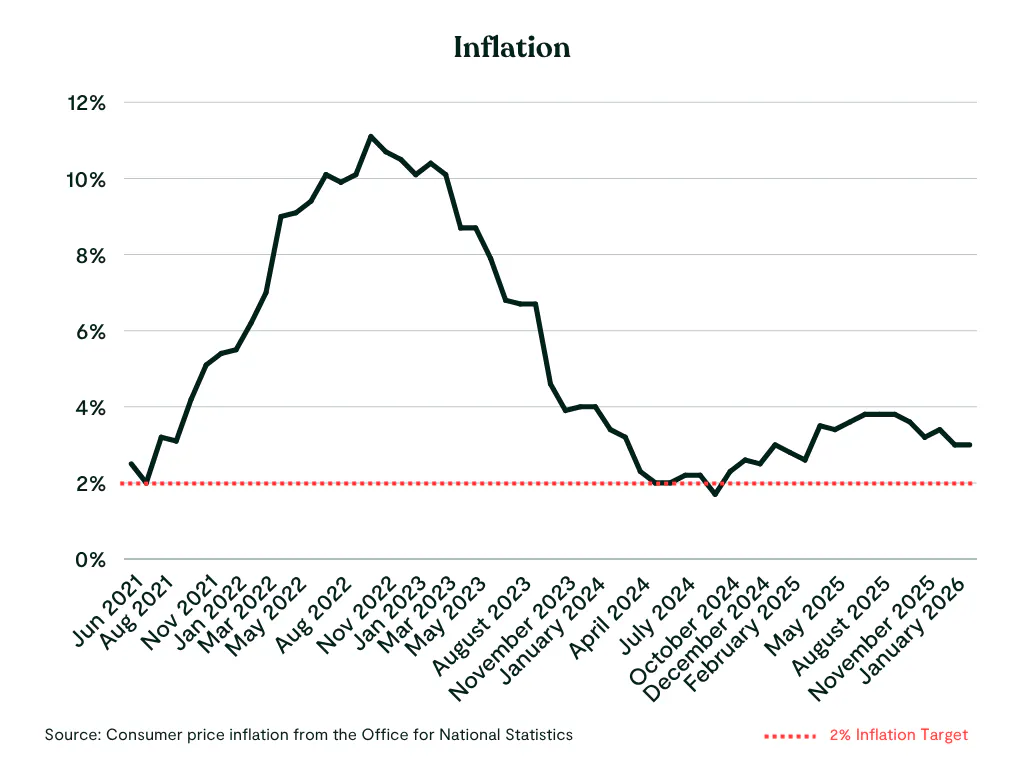
The latest inflation figures show that the current inflation rate (CPI) in the UK is 3.0%, holding steady from the month before. This is the lowest rate in 11 months, and in line with what the market was expecting, but still way above the Bank of England's 2% target. While this may seem like good news, this is likely to be the calm before the storm. The outlook for inflation has changed significantly since the start of the conflict in the Middle East, which has sent oil and gas prices skyrocketing.
Rewind to February, and the market was expecting inflation to fall, giving the Bank of England the wiggle room it needed ot cut its base rate of interest. However, at the MPC's latest meeting in March, they voted to hold interest rates at 3.75%. If the conflict continues, we could see inflation rise as the increase in oil prices has an impact on the wider economy, for example, through higher energy, transport and fuel costs for households and businesses.
If inflation does rise, it's likely the base rate will stay higher for longer and may not be cut for the rest of 2026. As mortgage lenders price in base rate cuts before they happen, if a base rate rise looks more likely, we could see lenders start increasing their own rates. We're already seen average mortgage rates jump back above 5% as lenders rapidly reprice fixed-rate deals off the back of rising inflation fears. See what rate you could get now without applying.
"All eyes are on the inflation rate to see the impact of the conflict in the Middle East on the wider economy. If inflation rises, we'll all feel it, not just in the mortgage rates being offered by lenders, but also in our wallets as higher costs could be passed onto customers."

Brad Wright
Senior Mortgage Advisor at Tembo
See what mortgage rates you could be offered
Complete your details online to see your best mortgage options from across our panel of over 100 lenders, including ways you could boost your buying power. Discover yours today!
How does inflation impact me?
Inflation impacts the general cost of living, as it affects the buying power of your money. When inflation rises, the price of everyday items and services increases. Interest rates also tend to increase, impacting the rates we can get on loans like mortgages and savings accounts. Rising inflation also means that wages have to work harder to keep pace with these increases, otherwise your earnings won't go as far as before!
When a person’s wages fail to keep up with inflation, they’ve effectively been given a pay cut, as their salary won't go as far if the cost of food, clothes, energy, petrol, and other living expenses has risen at a much faster rate.
Although the most recent figures have shown the annual average wage growth rate at 4.5%, when adjusted for inflation, the annual growth in real terms is a mere 0.6%.
You might like: How to ask for a pay rise
How does inflation affect mortgage rates?
When inflation drops, this gives the Bank of England more wiggle room to reduce the base rate. This is the rate the Bank of England charges other banks and lenders to borrow money, and is a lever the Bank can pull to curb inflation when it rises too high. The base rate was increased multiple times over 2023, but over 2024 it was cut twice, with the base rate now standing at 3.75% and is expected to stay at that level or even rise over 2026.
When the base rate goes up, this tends to influence mortgage lenders to increase their own interest rates. This can be bad news for borrowers, as it can lead to higher borrowing costs, making their debts less affordable, including mortgage repayments. But it's good news for savers if savings interest rates stay high, helping you to make your savings work harder.
You might also like: Is now a good time to save money?
Does inflation affect fixed rate mortgages?
If you have a fixed rate mortgage, you won’t see a change in your monthly payments when the inflation rate rises until the end of your fixed term. When your fixed term expires, you’ll usually be moved onto your lender’s standard variable rate, which rises and falls based on changes in the market, or you can remortgage onto a new fixed rate deal.
In the months before your fixed rate expires, it’s a good idea to start looking for a new mortgage deal. Luckily, this is something we can help you with. Our smart tech will compare thousands of mortgage deals across the market in an instant to find which ones you’re eligible for. Complete your details online to get started.
Discover how much you could boost your buying budget
We've helped thousands of buyers discover how they could boost what they could afford. On average, our customers increase their buying budget by £82,000. To find out which buying schemes you could be eligible for and how much you could afford, complete your details online.
Should I fix my mortgage?
If you’re on a variable rate mortgage or your current fixed rate mortgage deal is coming to an end, we recommend looking at both fixed rate and variable deals to compare what’s available. During periods of market volatility, a fixed deal can protect you from fluctuations.
For example, in the 1990s and early 2000s when interest rates fluctuated between 3.5% and 14.88%, those lucky enough to fix at the lower end of the scale were offered a lot of protection.
Equally, a variable rate mortgage can offer an opportunity to access lower interest rates and therefore lower monthly repayments. To understand whether a variable rate might suit you, calculate what your monthly repayments would be with the current market rates on variable mortgages. Add 1%, 2% and 3% to the interest rate and check the repayments. Does that seem comfortable for you? If not, the risk might not be worth the potential reward for you.
It’s always best to seek expert advice when it comes to deciding whether to fix your mortgage or not. If you feel overwhelmed looking at the different rates available, get in touch with our expert team.
Read more: How long should I fix my mortgage for?
How does inflation affect savings rates?
Inflation impacts interest rates for savings by influencing what rates savings providers can offer their customers. The Bank of England charges other banks and lenders to borrow money through the base rate. When the base rate goes up or stays high, this makes it more expensive for providers to loan money to their customers, so they typically will also raise their interest rates in response.
Inflation also impacts the purchasing power of your money. High inflation erodes the purchasing power of your money over time unless the interest you earn on your savings outpaces inflation. Banks may respond to high inflation by increasing savings rates to attract deposits, but the rates offered by big, well-known providers often still lag behind inflation. This is why looking for the most competitive rate - not just the biggest name - can help you make your money work harder and protect its purchasing power over time.
Earn up to 3x more interest vs the Big 4 banks with our easy access Cash ISAs
Plus, unlimited withdrawals, fee-free mortgage advice, and monthly paid interest.
Is inflation an issue in the UK?
While inflation has come down significantly from its peak of over 11% in 2022 - driven largely by soaring energy prices after Russia’s invasion of Ukraine - it had been hovering close to the Bank of England’s 2% target since mid-2024. However, there are now renewed fears that inflation could start rising again off the back of the conflict in the Middle East.
If inflation starts rising again, a base rate cut will become less likely. The Bank will need to balance cutting rates too soon with supporting the economy that's grappling with higher inflation. If anything, we're more likely to see the base rate increase than come down now. This will likely result in mortgage rates and savings rates rising.